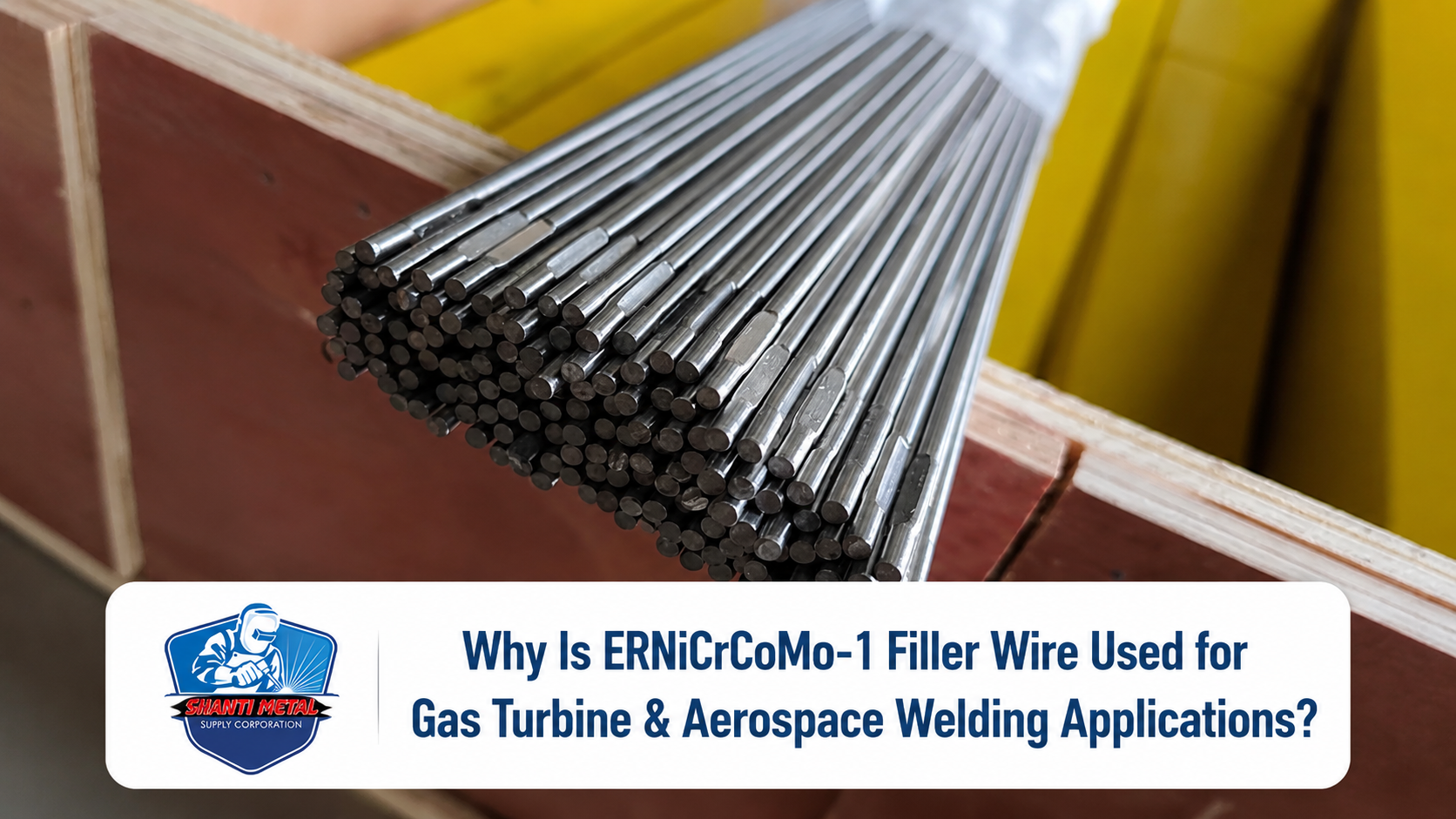
ERNiCrCoMo-1 filler wire is selected for welding applications where the weld metal must retain suitable strength, oxidation resistance and metallurgical stability at elevated temperatures. Standard consumables create weak weld metal that fails rapidly under the continuous cyclic stress and intense heat of aerospace service. ERNiCrCoMo-1 is a nickel-chromium-cobalt-molybdenum welding filler wire engineered for joining high-performance nickel-based alloys in exactly these conditions. Its combination of elevated-temperature strength, oxidation resistance, and weld metal stability makes ERNiCrCoMo-1 the standard specification for gas turbine fabrication and aerospace component welding where conventional stainless or low-alloy filler metals fall short.
What Is ERNiCrCoMo-1 Filler Wire?
AWS A5.14 identifies ERNiCrCoMo-1 as a nickel-based welding consumable for MIG (GMAW) and TIG (GTAW) welding. It deposits a weld metal compatible with nickel-chromium-cobalt-molybdenum base alloys such as Inconel 617 and other high-temperature superalloys, resulting in joints that retain the mechanical properties of the base metal at service temperatures. Its nickel-chromium-cobalt-molybdenum composition provides the weld metal with high-temperature strength, oxidation resistance and metallurgical stability.
Key Properties of ERNiCrCoMo-1 Filler Wire
| Property | Welding Advantage |
| High-Temperature Strength | Supports elevated-temperature applications without weld metal softening |
| Corrosion Resistance | Protects weld integrity in aggressive oxidising environments |
| Thermal Stability | Performs reliably during temperature cycling without microstructural breakdown |
| Alloy Compatibility | Suitable for nickel-based superalloy welding across the ERNiCrCoMo family |
| Weld Integrity | Supports reliable long-term service in pressure-critical components |
Cobalt additions stabilise the austenitic matrix at temperatures where nickel-chromium alloys without cobalt begin losing creep resistance. Molybdenum contributes solid-solution strengthening at elevated temperature and improves corrosion resistance in environments containing sulphur compounds common in gas turbine hot sections.
Why Is ERNiCrCoMo-1 Used in Gas Turbine Welding?
Gas turbine hot sections experience continuous operating temperatures between 900°C and 1,100°C alongside rapid thermal cycling during start-up and shutdown sequences. Weld joints in these components must retain the same creep resistance, oxidation resistance, and fatigue life as the surrounding base metal any property mismatch between weld metal and base material creates a stress concentration point that initiates cracking under cyclic thermal load.
ERNiCrCoMo-1 deposits weld metal that matches Inconel 617’s elevated-temperature properties closely enough to avoid this mismatch, which is why it is specified for turbine fabrication and repair rather than lower-cost filler metals that cannot sustain the thermal environment.
Turbine Hot-Section Components
Combustion liners, transition ducts, and nozzle guide vanes operate continuously at temperatures that demand weld metal retaining full mechanical integrity without creep deformation over tens of thousands of operating hours. ERNiCrCoMo-1 provides the heat-resistant weld metal these components require throughout their service life.
Gas Turbine Repair & Maintenance
Repair welding on turbine components exposed to thermal cycling and oxidation requires a filler metal that bonds with thermally degraded base material without introducing new cracking susceptibility. ERNiCrCoMo-1’s compatibility with Inconel 617 and similar alloys makes it the consumable of choice for component restoration work where base metal condition after service varies from the original specification.
Applications of ERNiCrCoMo-1 in Aerospace Welding
Aerospace structures and propulsion components face strict qualification requirements weld metal must demonstrate consistent mechanical properties across production batches and maintain those properties through the thermal and mechanical loading the component experiences in service. ERNiCrCoMo-1 meets aerospace welding procedure qualification requirements for nickel-based superalloy joints, providing the oxidation resistance and thermal stress tolerance that structural aerospace welds demand.
Engine and Combustion Components
Jet engine combustion chambers, afterburner linings, and exhaust system components weld with ERNiCrCoMo-1 where the joint must survive rapid thermal cycling between ambient and operating temperature without fatigue cracking at the weld toe or heat-affected zone.
Aerospace Component Repair
Maintenance, repair, and overhaul (MRO) operations on aerospace engine hardware require filler metals that restore original material properties while maintaining compatibility with the base alloy’s heat treatment response. Selecting an incompatible filler at this stage compromises the repair’s service life regardless of welding technique quality.
Key Factors to Consider When Selecting ERNiCrCoMo-1
- Base Metal Fit: First, you must examine the chemistry of your base alloy. Don’t assume that one nickel filler metal will work for every high-temp superalloy.
- Operating Conditions: Make sure that your heat and thermal cycling really need cobalt-moly strength; alternatively, a simpler Ni-Cr wire may work.
- Welding Method: Thin portions require TIG for clean, precise root passes, while bigger connections benefit from MIG for faster fill.
- Specs and Paperwork: Review AWS A5.14, EN 18274 test reports and WPS approvals before ordering.
Why Choose ERNiCrCoMo-1 for High-Temperature Welding?
No single property justifies ERNiCrCoMo-1’s selection it is the combination of thermal stability, oxidation resistance, creep strength, and base-metal compatibility that makes it suitable where lower-cost alternatives introduce failure risk. For gas turbine fabrication, aerospace component manufacture, and high-temperature industrial welding involving nickel-based superalloys, filler metal selection directly determines joint service life. Shanti Metal stocks ERNiCrCoMo-1 in TIG wire and MIG spool configurations with full AWS A5.14 certification and material traceability.
Conclusion
ERNiCrCoMo-1 filler wire suits gas turbine and aerospace welding because its alloy composition matches the thermal, mechanical, and corrosion demands of the nickel-based superalloys it joins, maintaining weld integrity through the operating conditions that alternative filler metals cannot sustain. Selecting the correct consumable at specification stage prevents joint failures that are far more expensive to address in service than at procurement. Review the complete technical specifications and international certifications for ERNiCrCoMo-1 available at Shanti Metal.